
Infantino’s Failed World Cup Sell-Off Proves He Has to Go
The following is an opinion piece and reflects the views of the author, not necessarily those of 48ninety Sports.
For a few days this summer, FIFA president Gianni Infantino tried to do something no one in the history of the sport’s governing body had ever attempted: sell a piece of the World Cup itself to private investors. That the plan collapsed within a week under the weight of near-universal condemnation should not be read as a system working as intended. It should be read as confirmation of exactly how far Infantino was willing to go, and how little separates FIFA’s leadership from the extractive instincts of the industries it claims to stand apart from.
What Was Actually Proposed
The plan, branded internally as FIFA Forward Enterprise, would have folded FIFA’s commercial operations, broadcasting, sponsorship, ticketing, and licensing, along with the operational running of its tournaments, into a single new subsidiary valued at roughly $20 billion. Private investors, reportedly including the Kushner family, would have bought in. Each of FIFA’s member federations was dangled a one-time payment of $20 million to sign off by a September deadline.
It fell apart fast. Two senior FIFA figures broke ranks publicly within days: presidential adviser Carlos Cordeiro resigned, saying plainly that he could not stand by while FIFA considered selling a stake in the World Cup, and FIFA’s own chief operating officer told reporters that staff had been kept in the dark about the scope of what Infantino was planning. UEFA threatened to pull its 55 member federations out of the World Cup competition entirely if the plan proceeded, a threat with enough teeth to force Infantino’s hand. Within days, the project was dead, with Infantino conceding in a statement that it had created divisions and that no version of the plan was worth sustaining.
The Timing Is the Real Story
Here’s what makes this impossible to separate from pure greed: this proposal surfaced almost immediately after FIFA finished counting the receipts from the 2026 World Cup, a tournament that generated north of $15 billion in revenue for an organization that still, on paper, operates as a not-for-profit. That distinction has always given FIFA cover. It lets the organization sit outside the normal scrutiny applied to a business of its size, while its leadership travels, negotiates, and lives like one anyway. A $20 billion private equity vehicle built around the World Cup’s commercial rights is not the behaviour of a steward of the game. It’s the behaviour of an executive who watched a windfall come in and decided the not-for-profit label was an inconvenience to be engineered around.
And it’s worth being honest about where that windfall actually came from. The 2026 tournament was marketed as a joint effort between the United States, Canada, and Mexico, but the numbers tell a more one-sided story: the U.S. hosted 78 of the tournament’s 104 matches, including every game from the quarterfinals through the final, while Canada and Mexico combined for 26. A tournament that concentrated, that thoroughly, in one country’s stadiums, television deals, and sponsorship markets, produced the kind of American commercial windfall that appears to have convinced Infantino the World Cup itself could be commodified the same way. Calling it a joint hosting is generous. The proceeds, and apparently the ambition that followed them, were overwhelmingly American in character.
Credit Where It’s Due
If there’s a bright spot in this episode, it’s that the sport’s regional federations didn’t roll over. UEFA’s threatened boycott did the most damage to the plan, but it wasn’t alone. Asia’s confederation, the AFC, joined the opposition, as did CONCACAF, the North and Central American body that represents the very region that just hosted the tournament FIFA wanted to monetize further. Having three confederations spanning Europe, Asia, and North America unite against a sitting FIFA president in real time is not a small thing, and it’s the only reason this plan didn’t advance further than a week of headlines. That kind of coordinated pushback deserves real credit, and it’s a template for how the game’s stakeholders should respond the next time Infantino tries something like this, because on his track record, he will.
This Isn’t a One-Off
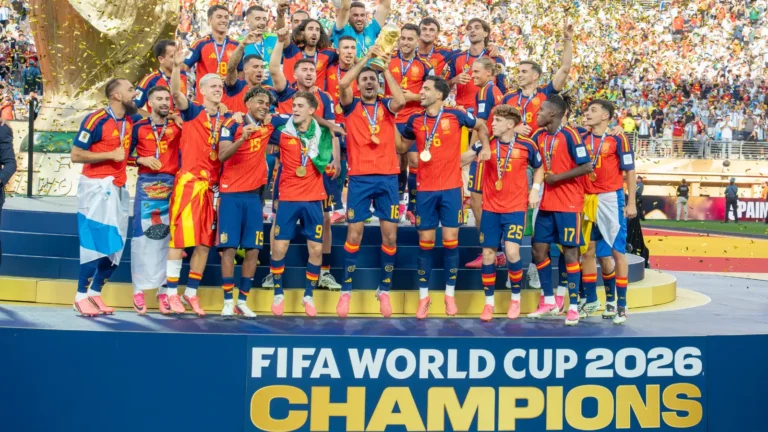
Infantino scrapping the plan doesn’t undo the pattern it fits into. The 2026 World Cup itself produced a run of controversies that, taken individually, might read as noise, but taken together paint a picture of a governing body that keeps finding itself on the wrong side of fairness. Argentina was moved out of its originally drawn group during the live December draw, shifted from Group I into Group J. FIFA’s explanation was procedural, a seeding rule preventing the top four ranked teams from sharing a knockout pathway, but the lack of a clear, real-time explanation during the broadcast itself was enough to fuel lasting suspicion that has never fully gone away. Separately, a red card issued to USA forward Folarin Balogun against Bosnia and Herzegovina had its suspension lifted after a call for review from the U.S. president, allowing Balogun to play in the very next match, a decision cheered domestically and criticized everywhere else as the kind of political interference a credible disciplinary process should never entertain. Add in Egypt’s disallowed goal against Argentina and its rejected bias complaint, England’s disputed equalizer against Norway, and the chaotic disciplinary fallout after Argentina’s players clashed with Spain following the final, and you have a tournament where the credibility of officiating and governance was in question almost as often as the football itself was praised.
None of these controversies is proof of a conspiracy on their own. But an organization with FIFA’s history, the 2015 corruption arrests that gutted its leadership, and the sustained allegations that trailed the Qatar 2022 hosting decision does not get the benefit of the doubt anymore. It has spent that credit. When a body with that record tries to sell off the crown jewel of its sport to private investors two months after a tournament defined by officiating controversy, the appropriate response isn’t measured scepticism, but rather alarm!
Infantino Has to Go
Scrapping a bad plan under pressure is not leadership. It’s damage control. Infantino didn’t abandon this proposal because he had a change of heart about turning the World Cup into a commercial asset class; he abandoned it because UEFA, the AFC, and CONCACAF made the political cost of continuing higher than he was willing to pay. That is not the record of someone who should still be trusted with the sport’s governing body. The World Cup does not need a president who has to be talked out of selling it. It needs one who never considered it in the first place. Gianni Infantino should resign, and football’s stakeholders should not wait for the next scheme before deciding he’s no longer fit to lead it.
What’s your take on Infantino’s leadership and this scrapped deal? Let us know in the comments.